ZPSim Product Introduction
Multi-physics simulation platform for solver lines, semiconductor routes, coupled workflows, and application-oriented engineering systems.
ZPSim is not a single solver window. The current platform scope already spans 115 top-level technical packages and 19 application-oriented families across solver kernels, coupling layers, mesh and IO infrastructure, benchmark systems, CLI execution routes, and industry-facing engineering packages.
The current strongest delivery surface is the verified execution chain where the same case can be prepared, solved, checked against benchmark or reference behavior, and rerun under controlled solver conditions. Around that core, the platform already exposes broader lines across electromagnetics, CFD, acoustics, aeroelasticity, explicit dynamics, optical, plasma, and domain-specific application packages.
The platform scope also reaches into semiconductor and engineering-program routes through EDA, ZPSim_EDA, EM-EDA circuit support, chiplet-oriented paths, TCAD, photoresist, manufacturing, optimization, and data-flow layers. That breadth matters because the product can describe physics, execution, validation, and application context inside one platform family.
Core thermal, structural, and coupled thermal-stress solving
Run the most evidence-rich solver lines through repeatable case execution, comparison, and engineering review.
- Steady and transient thermal workflows
- Structural baseline and same-input comparison cases
- Thermal-stress paths that connect thermal loading to structural response
Broader physics families under the same platform
Keep additional solver lines visible and organized inside the same product family instead of scattering them across separate project silos.
- Electromagnetics, CFD, acoustic, aeroelastic, and explicit dynamics
- Optical, plasma, combustion, chemical-process, and quantum-oriented lines
- Dedicated overview and benchmark surfaces for multiple domain stacks
Semiconductor and EDA-oriented engineering routes
Extend beyond general-purpose multi-physics into circuit-adjacent and semiconductor-facing engineering paths that can share the same platform infrastructure.
- EDA and ZPSim_EDA routes connected to EM and circuit-facing workflows
- Chiplet, TCAD, and photoresist-oriented package lines inside the current source base
- Shared execution, validation, and data layers that can support future productization
Coupled workflows and numerical-method breadth
Support engineering programs that need more than one physics line or more than one numerical method in the same product environment.
- Coupling layers such as CHT, FSI, electromagnetic-thermal, and multi-physics orchestration
- Method families spanning FEM, XFEM, MPM, DEM, SPH, LBM, IGA, and more specialized kernels
- Shared mesh, data, solver, and post-processing infrastructure across domains
Application-oriented engineering packages
Move from pure physics modules into domain-specific engineering systems that already have their own package surfaces.
- Aircraft engine, hypersonic, stealth aircraft, and underwater detector packages
- Biomedical, power system, mass spectrometer, particle accelerator, and telescope packages
- Design-platform packages such as chiplet, radar, and other application-oriented engineering tracks
CLI, benchmark, validation, and platform infrastructure
Keep solver execution measurable through command-line routes, benchmark cases, compare artifacts, and platform-level infrastructure rather than one-off demonstrations.
- CLI execution entry points and file-driven workflows
- Benchmark, validation, mesh, IO, solver, and post-processing layers inside the same platform
- Parallel, distributed, and GPU-facing infrastructure for broader execution scaling
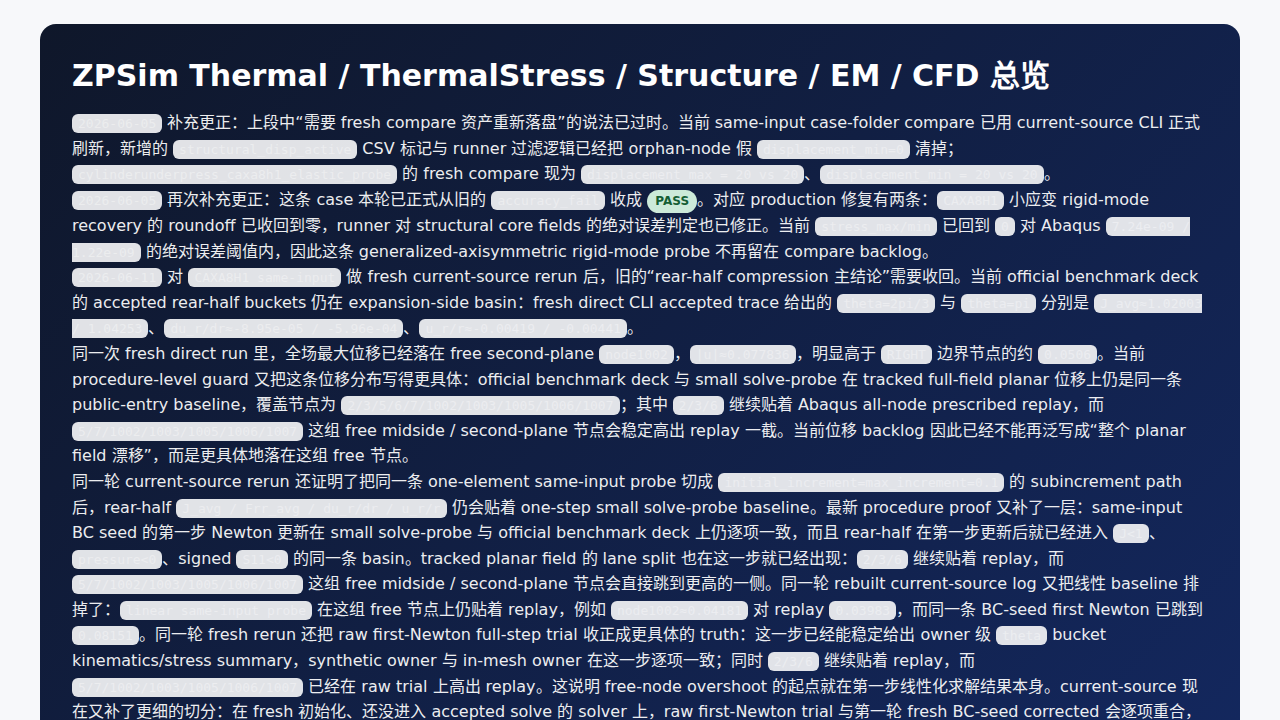
Platform overview
The current overview gathers core solver lines, broader physics families, benchmark-facing assets, and application-oriented package direction into one platform-facing entry.
Start from the target engineering problem, the required solver family, or the application-oriented package that matches the job.
Build the case from geometry, mesh, material, load, boundary, or deck-driven input according to the selected workflow.
Continue through a physics solver line, a semiconductor-facing route, or an application package depending on the actual delivery target.
Execute the thermal, structural, EM, CFD, acoustic, semiconductor, or coupled-field line through the current runtime and solver configuration.
Check result metrics, parity data, generated artifacts, and support-boundary evidence before accepting the run.
Carry the same platform into the next physics line, coupling route, semiconductor route, or application package when the engineering program needs broader coverage.
Field solving, extraction, and semiconductor-facing simulation can stay in one platform story
EM, EDA, EM-EDA circuit support, chiplet-oriented routes, TCAD, and photoresist-facing lines make the platform relevant for customers working around advanced packaging, device behavior, and circuit-adjacent simulation tasks.
Programs that cross structures, fluids, aeroelasticity, and signature-related analysis fit naturally here
Aircraft engine, hypersonic, stealth-aircraft, and underwater-detector package lines show that the platform can be positioned around mission systems and high-consequence engineering programs rather than isolated solver menus.
Thermal, structural, CFD, and power-system work can be presented as one engineering environment
Power-system packages, coupled thermal workflows, fluids, combustion, and broader multi-physics infrastructure make the platform suitable for teams that need repeated engineering evaluation instead of one-off model runs.
Application-facing packages already exist for specialized scientific systems
Biomedical, mass spectrometer, particle accelerator, and telescope-oriented package lines show that the platform can be framed around domain outcomes, not only around abstract solver families.
Multiple numerical routes can be carried inside one controlled platform
FEM, XFEM, MPM, DEM, SPH, LBM, IGA, coupled-field orchestration, and validation layers give research-oriented teams a place to expand methods without losing operational discipline.
Solver execution, validation, and repeatability are part of the sellable product surface
CLI execution, benchmark management, validation, post-processing, mesh, IO, distributed execution, and GPU-facing layers matter because engineering customers often buy the ability to rerun and govern workflows, not just to open a model.
The current product scope is already much larger than a three-line solver story.
The current source base already spans broad platform infrastructure across solver modules, coupling layers, application packages, benchmark systems, and command-line execution surfaces.
- Top-level technical packages
- 115
- Application-oriented families
- 19
- Dedicated overview pages
- 11 domain-level overview surfaces
The strongest current proof line is still real benchmark and compare work.
The thermal and thermal-stress lines already provide the clearest customer-facing evidence because the compare values and coupled execution paths are explicit and repeatable.
- DCC3D8
- Relative error 0.0028301751, 13.828 s vs 145.554 s
- Case05 thermal-stress
- Full-field relative error 3.225827416974837e-07
- EC3KTRSJ
- Relative error 0.011884125359039642
Structural capability is tracked through gates rather than vague completion claims.
The structural line is already presented with counted baselines, gate totals, and case-level accuracy labels, which makes it suitable for disciplined engineering discussion.
- Counted baseline
- 8 of 8 PASS
- Family gates
- 14 of 14 PASS
- Example case
- xmpcline relative error 0.0033381074
The EM line already has a much deeper gate stack than the current page suggests.
The current EM mainline is organized around high-frequency frequency-domain FEM and EDA extraction work, with FDTD kept as a quality-support line.
- solver_smoke
- 118 of 118 PASS
- solver_accuracy
- 6 of 6 PASS
- HFSS parity
- 5 of 5 PASS
CFD already has a defined mainline and active contract gates.
The current CFD direction is not a loose placeholder. It is organized around CFDCommon, ZPPureCFD, and ZPFluid, with benchmark and fail-closed contract gates already active.
- CFD mainline
- CFDCommon + ZPPureCFD + ZPFluid
- PureCFD active gate batch
- 10 of 10 PASS
- Fluid-side contract batch
- 4 of 4 PASS
Additional physics lines already expose their own evidence and boundaries.
Acoustic, aeroelastic, and explicit-dynamics are already far enough along that they need to be described with their own gate and support-boundary language rather than hidden under a single “future roadmap” sentence.
- Acoustic
- 4 smoke gates plus 3 INP parser gates
- Aeroelastic
- Stable library with gated modal, K-method, and P-K workflow proof
- Explicit dynamics
- 5 LS-DYNA smokes and CLI run path behind explicit solve gate
The current platform scope already reaches into semiconductor-facing engineering work.
The source base does not stop at physics solvers. It already includes EDA, ZPSim_EDA, EM-EDA circuit support, chiplet-oriented routes, TCAD, and photoresist-facing lines that belong in the public product story.
- Named platform routes
- EDA, ZPSim_EDA, EM_EDA_Circuit_Common
- Semiconductor tracks
- Chiplet, TCAD, Photoresist
- Product implication
- Simulation, extraction, and application packaging can stay under one platform family
The product footprint also includes the layers that make repeated engineering execution possible.
ZPSim already carries command-line execution, benchmark management, validation, mesh, IO, solver, post-processing, distributed execution, parallel, and GPU-facing layers as visible platform components.
- Execution and review
- CLI, Benchmark, Validation, PostProcessing
- Core runtime layers
- Mesh, IO, Solver, NumericalMethods, MultiPhysics
- Scaling layers
- Parallel, DistributedComputing, GPU_Common
The platform already extends into domain systems, not only physics kernels
Current application-oriented packages already cover aircraft engine, biomedical, power system, mass spectrometer, particle accelerator, stealth aircraft, underwater detector, telescope, hypersonic, and broader design-platform tracks.
The current platform story should already include circuit-adjacent engineering routes
EDA, EM-EDA, chiplet, TCAD, and photoresist-facing lines show that ZPSim is already crossing from general simulation into semiconductor-oriented engineering packaging.
Execution is designed to be rerun and inspected
The platform keeps command-line routes, benchmark outputs, compare artifacts, validation tables, and domain-specific overview surfaces available so teams can rerun the same engineering path under controlled conditions.
The product is broader than one numerical-method choice
The current platform scope already spans multiple method families including FEM, XFEM, MPM, DEM, SPH, LBM, IGA, TwoFluid, and broader multiphysics orchestration layers.
The platform includes more than front-end solver entry points
Mesh, IO, solver, numerical methods, post-processing, validation, parallel, distributed, and GPU-facing layers are already part of the product footprint.
The product story should stay broad without becoming vague
The right product description for ZPSim is not “everything is done.” It is a large platform with strong validated lines, active expansion lines, and explicit domain-by-domain support boundaries.