ZPMesh Product Introduction
Industrial meshing foundation module for surface and volume discretization, quality improvement, and export handoff.
ZPMesh is an industrial software foundation module for teams that need surface meshing, tetrahedral generation, mesh optimization, and engineering export inside one controllable workflow. The current public evidence is strongest on the volume-mesh and quality-improvement path.
It fits preprocessing work where geometry has to be turned into a usable analysis mesh, checked, improved, and delivered downstream with stable statistics and repeatable execution.
Surface and tetra mesh generation
Generate the mesh structures needed by downstream simulation work instead of stopping at geometry import.
- Surface meshing for boundary representation
- Tetrahedral volume meshing
- Octree and Delaunay-oriented generation paths
Mesh quality improvement
Improve element quality before the mesh is passed into analysis, with visible metrics that show whether the optimization step paid off.
- Average quality improvement loops
- Aspect-ratio reduction
- Validation output for before-versus-after review
Parameter-controlled refinement
Change mesh density and sizing behavior based on the engineering target instead of running one fixed discretization recipe.
- Coarse-to-fine size-map control
- Parameter sweeps
- Performance-aware batch runs
Engineering export workflows
Move the generated mesh into the next solver or preprocessing stage through stable import and export surfaces rather than one-off scripts.
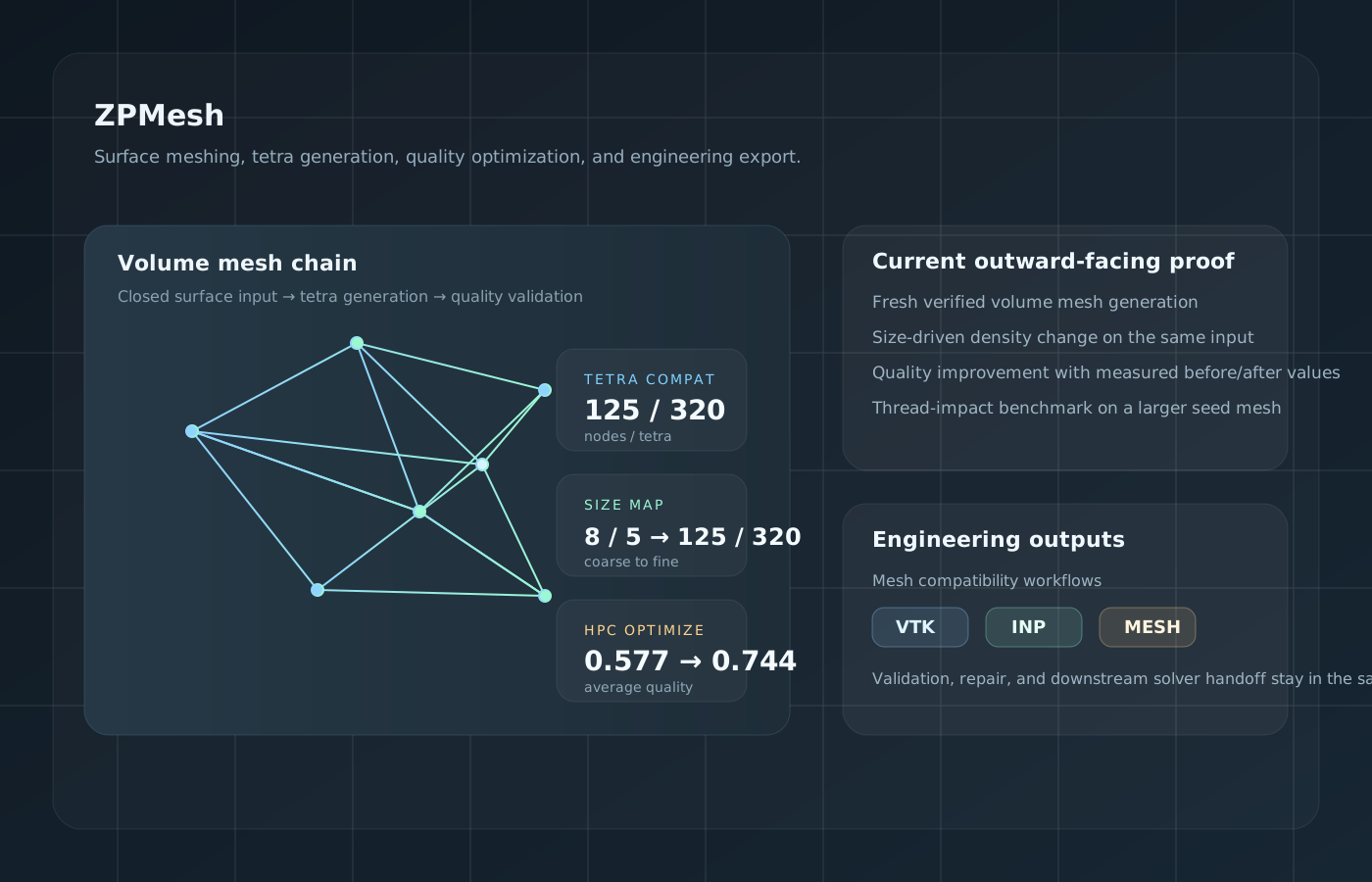
Meshing workflow overview
The module surface covers geometry intake, surface and tetra generation, quality measurement, optimization, and export for downstream engineering use.
Start from the geometry or benchmark case that needs a surface or volume mesh.
Run surface and tetra generation with the parameter set that matches the target density and case scale.
Measure quality, apply optimization, and compare the post-process result against the original mesh state.
Deliver the checked mesh to the next engineering or solver stage with the required format and statistics.
Verified tetra generation already closes on a compact case.
The current tetra compatibility example already provides a clean customer-facing proof point for basic volume generation.
- Case
- meshgems_tetra_compat
- Mesh size
- 125 nodes, 320 tetra
- Run time
- 0.0950431 s
Density change is visible through the same compatibility path.
The current size-map example already shows a clear coarse-to-fine difference.
- Coarse mesh
- 8 nodes, 5 tetra
- Fine mesh
- 125 nodes, 320 tetra
- Case
- meshgems_tetra_sizemap_compat
Quality improvement already carries measurable gain.
The optimization path is one of the strongest outward-facing proof lines because the numbers move in the expected direction with a visible margin.
- Average quality
- 0.577350 to 0.744379
- Gain
- +28.93%
- Aspect ratio
- 3.147345 to 2.441934, down 22.41%
Large-seed benchmarks already expose thread-level comparison.
The current param-sweep benchmark gives the reader a concrete idea of mesh scale and runtime change under multiple thread counts.
- Mesh size
- 729 nodes, 2560 tetra
- Threads
- 1 / 2 / 4
- Times
- 5.847735 s / 5.491656 s / 5.330595 s